
Champaign County Court Records After a Jail Arrest
After a Champaign County arrest, the first public trail may be a booking at Tri-County Regional Jail, the regional jail serving Champaign, Madison, and Union Counties. The court record starts when a complaint, information, indictment, citation, bond entry, hearing notice, or other filing is opened in court. Municipal Court handles many misdemeanors, traffic criminal matters, and early felony complaint activity. Common Pleas Court and the Clerk of Courts handle felony cases, indictments, appeals-related filings, liens, and other legal division records.
The custody side and the court side should be checked separately. For current jail custody, roster updates, release logistics, and inmate location, use jail inmate records. For booking photos and photo-request limits, use jail roster mugshots. Court records after an arrest focus on filed charges, case numbers, docket events, bond entries, warrants, disposition, costs, and orders signed by the judge.
How to Find Court Records After an Arrest in Champaign County
Start with the system that matches the charge path. The Champaign County Municipal Court is located at 205 S. Main Street, P.O. Box 67, Urbana, Ohio 43078, and lists traffic and criminal arraignments for Monday, Tuesday, Wednesday, and Friday at 9:00 AM. The Municipal Court public access link opens an Authority Web Connect portal. For Common Pleas criminal cases, the Champaign County Clerk of Courts Legal Division points users to its court-record search and notes that verified information is available by phone or in person because online records can lag behind filings and judicial action.
- Confirm whether the person is or was in local custody through the Tri-County roster or jail phone line.
- Decide which court likely has the case: Municipal Court for many misdemeanors, traffic criminal cases, and initial felony complaints; Common Pleas for felony indictments and Common Pleas criminal filings.
- Search by defendant name or case number in the matching court portal.
- Open the docket and read each charge, offense level, filing date, bond entry, hearing date, and current disposition.
- Call the court or Clerk if the portal data appears stale, incomplete, or unclear.
Ohio statewide custody tools do not replace local court records. The Ohio Department of Rehabilitation and Correction offender search is for people incarcerated, released, under Adult Parole Authority supervision, or violators at large in the state prison system. Federal Bureau of Prisons and ICE locators cover federal and immigration custody, not Champaign County Municipal or Common Pleas dockets.
Court Portal and Office Access for Arrest-Related Records
The captured Champaign County Municipal Court Authority Web Connect page shows the public-access disclaimer users must accept before reaching case information.
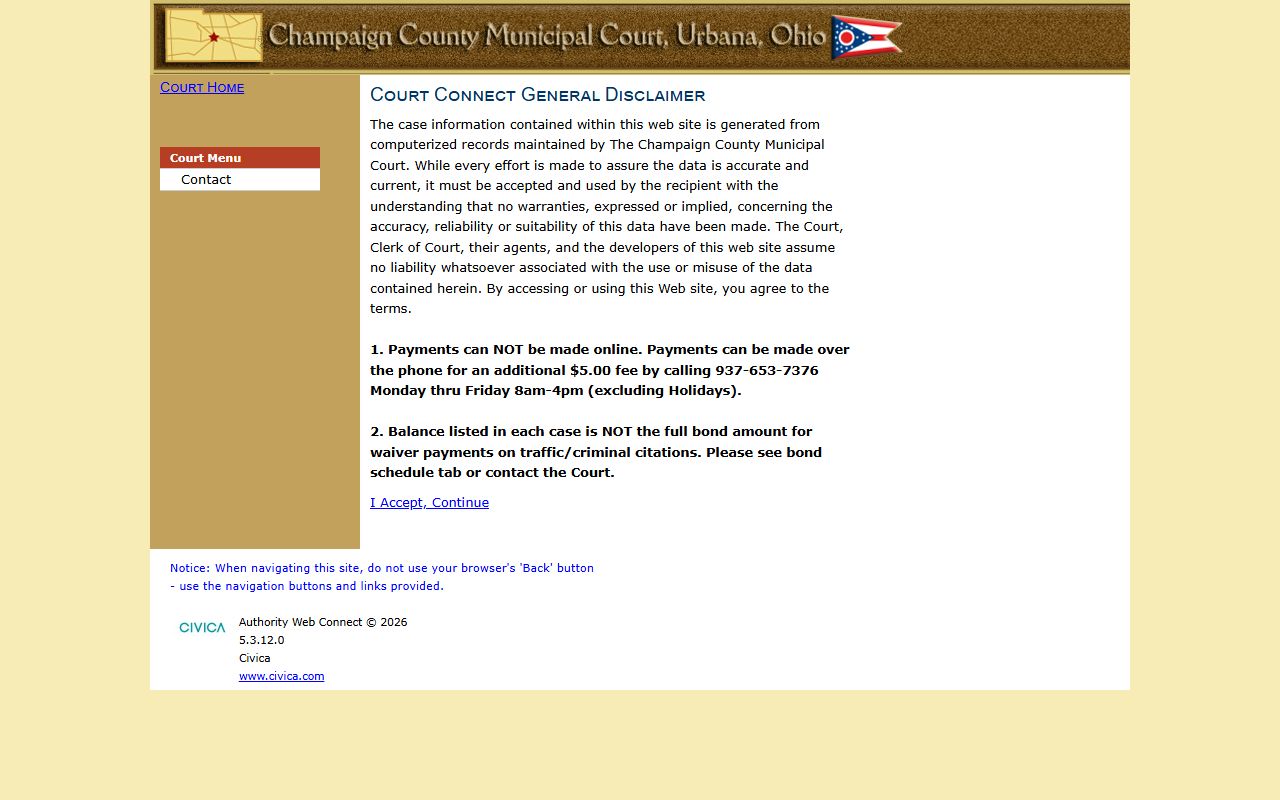
That disclaimer matters because the portal warns that case data comes from computerized court records, no warranties are made, online payments are not accepted there, and listed balances are not full bond amounts for waiver payments on traffic or criminal citations.
| Portal or Office | Use It For | Access Notes |
|---|---|---|
| Municipal Court Authority Web Connect | Municipal criminal, traffic criminal, arraignment, docket, bond, and payment-status information. | Requires JavaScript and disclaimer acceptance. The portal says payments cannot be made online. |
| Clerk Common Pleas eServices | Common Pleas Court records, felony cases, legal division filings, and related case events. | Session-based access may require a normal browser. Call 937-484-1047 for verified legal division information. |
| Common Pleas Court Records | Official Common Pleas record-access landing page linking users to court records. | Use when the charge has moved beyond Municipal Court or appears as a Common Pleas criminal case. |
| Clerk Legal Division counter | Certified copies, verified filings, and in-person record access. | 200 N. Main St., Urbana, Ohio 43078. The legal page lists certified copies at $2 and exemplified or triple-seal certified copies at $3. |
How Charges Get Filed After an Arrest: Complaint, Information, and Indictment
A jail arrest does not freeze the case exactly as it appears at booking. The arresting officer may list an initial offense, then the prosecutor reviews reports and decides what charge to pursue. Champaign County uses a county prosecuting attorney rather than a district attorney. The Ohio Prosecuting Attorneys Association identifies Hon. Kevin S. Talebi as the Champaign County Prosecuting Attorney. His office is listed at 200 North Main Street, Urbana, OH 43078, phone 937-484-1900.
Formal charging can move through different documents depending on the offense level and court path. A complaint often begins a Municipal Court case or initial felony proceeding. An information is a prosecutor-filed charging document used in some felony paths. An indictment follows grand jury action and usually places the criminal case in Common Pleas Court.
| Complaint | Information | Indictment | |
|---|---|---|---|
| Filed By | Law enforcement or prosecutor, depending on case type. | Prosecutor. | Grand jury returned through the prosecutor. |
| Common For | Misdemeanors, traffic criminal matters, and early felony complaints. | Felony cases where the procedural path allows prosecutor filing. | Felony cases presented to a grand jury. |
| Starts or Advances | The first court case or initial charge record after arrest. | A formal felony charge in the court record. | A Common Pleas criminal case or felony count. |
| What to Check | Case number, offense, arraignment date, bond, and next hearing. | Filed counts, offense level, plea deadlines, and judge entries. | Indicted counts, arraignment, bond status, and Common Pleas docket events. |
Charge Status in Court Records After a Jail Arrest
Charges can change after the booking record is created. A booking entry may show the arresting agency's initial allegation, while the court record later shows a prosecutor-filed charge, an amended count, a dismissed count, a reduced offense, or a grand jury indictment. Treat the docket as the better source for charge status, but treat the court clerk as the source for verified and timely information when online data is delayed.
| Status | What It Means | What to Verify |
|---|---|---|
| Pending | The charge remains active and has not reached final disposition. | Next hearing date, bond conditions, and whether the case moved courts. |
| Amended or Reduced | The charge changed from the original filing, often by plea negotiation, prosecutor action, or court order. | Original count, amended count, offense level, and date of amendment. |
| Dismissed | The court record shows the charge was dismissed and is no longer being prosecuted in that case. | Whether dismissal was with or without prejudice and whether other counts remain. |
| Nolle Prosequi | The prosecutor declined to continue that charge or count in the current case. | Whether the docket reflects final closure or another related case number. |
| Convicted | A plea, verdict, or court finding resulted in a conviction on the listed offense. | Sentence, costs, probation terms, jail credit, and appeal deadlines if relevant. |
Bond and Release After an Arrest
Bond information can appear in both custody records and court records. Tri-County Regional Jail can confirm current custody, release logistics, and whether a hold is blocking release. Municipal Court and Common Pleas Court records show court-set bond, bond changes, failure-to-appear events, and payment instructions. The Municipal Court portal specifically warns that a listed case balance is not the full bond amount for waiver payments on traffic or criminal citations.
For Municipal Court matters, call 937-653-7376 when bond information is unclear. The court research says phone payments are available for an additional $5.00 fee Monday through Friday from 8 AM to 4 PM, excluding holidays, but payment procedure should still be confirmed before money is sent. For Common Pleas legal division records, call the Clerk at 937-484-1047. For jail release logistics, call Tri-County Regional Jail at 937-834-5000.
| Bond Type | How It Works |
|---|---|
| Cash Bond | Money is posted directly as ordered by the court. Confirm the exact posting location and accepted payment methods before arriving. |
| Surety Bond | A permitted bail bond agent or surety posts the bond. The court order controls whether surety is allowed. |
| Recognizance or Own Recognizance | Release is based on a promise to appear, sometimes with supervision, reporting, or other conditions. |
| Ten Percent or Deposit Bond | Some Ohio courts may order a percentage deposit rather than the full amount up front. |
| No-Bond Hold | Payment alone will not release the person because a judge, detainer, warrant, probation hold, parole hold, federal hold, ICE detainer, or other agency hold blocks release. |
Warrants That Lead to an Arrest and Court Records
No official Champaign County Sheriff active warrant list was confirmed in the captured research. A warrant-related arrest may still appear through the court that issued the warrant, the Sheriff's Office contact channels, or the jail after booking. Use court records first for bench warrants, failure-to-appear entries, and warrant returns tied to a case. Use the Sheriff's Office or Records Division for report requests when the record is a law-enforcement record rather than a court docket.
The practical fallback chain is Municipal Court at 937-653-7376 for Municipal Court matters, Clerk/Common Pleas at 937-484-1047 for felony and Common Pleas docket records, Sheriff's Office main records contact at 937-484-6091, and non-emergency dispatch at 937-653-3409 when the question is operational rather than a records-counter issue. Emergency 911 is not a records lookup channel. VINE can help after a person is booked, but it is a custody-notification service, not a warrant search.
Charges vs. Convictions in Court Records After an Arrest
A charge is an accusation filed in court. A conviction is the result of a guilty plea, no-contest plea with finding, verdict, or other court finding that establishes guilt under the case record. This distinction is central when reading Champaign County court records after a jail arrest because the docket may show several filed charges even though only one count leads to a conviction, or none do.
| Charge | Conviction | |
|---|---|---|
| Stage | Filed allegation after arrest or prosecutor review. | Final result from plea, verdict, or court finding. |
| Proof Level | Based on probable cause or charging decision, depending on the document. | Requires proof beyond a reasonable doubt or an accepted plea. |
| Record Meaning | Shows what the person was accused of in court. | Shows the offense that resulted in judgment. |
| Lookup Caution | May later be amended, dismissed, reduced, or superseded by indictment. | Check sentence, costs, probation, jail credit, appeal, and sealing status. |
Sealed vs. Expunged Arrest and Court Records
Ohio law provides sealing and expungement paths for eligible criminal records, but eligibility depends on the offense, case result, waiting period, prior record, and court order. Research identified Ohio Revised Code 2953.32 for eligible convictions, R.C. 2953.33 for dismissals, not-guilty findings, grand jury no bills, and pardons, and R.C. 2953.34 for the effect of sealing or expungement orders. The Champaign County Clerk legal page lists a sealing-of-record filing fee of $50.
| Sealed | Expunged | |
|---|---|---|
| Public Visibility | Hidden from ordinary public access after a valid court order. | Destroyed, deleted, or treated under the statutory expungement effect when ordered. |
| Agency Access | Some law-enforcement, court, licensing, or statutory access may remain. | Access is more limited, but the order and statute control the exact effect. |
| Common Trigger | Eligible conviction, dismissal, not-guilty finding, no bill, or pardon. | Eligible case categories where Ohio law allows expungement rather than only sealing. |
| Practical Step | File in the court that has the record and follow local clerk instructions. | Present the order and written request to offices or agencies holding the case record when R.C. 2953.34 applies. |
Background Check Considerations
Public court lookup is not the same as a legally compliant employment, tenant, credit, insurance, or licensing background check. Online dockets may omit sealed records, lag behind filings, abbreviate charge language, or show dismissed counts beside active counts. A reader checking a Champaign County arrest-related case should verify the final disposition with the originating court, especially before relying on the record for any serious decision.
Important: This site is not a consumer reporting agency and court or jail information here may not be used for FCRA-covered decisions.
Restricted Court Records After an Arrest in Champaign County
Ohio's Public Records Act, R.C. 149.43, generally gives access to public records kept by public offices, subject to exemptions. The Ohio Attorney General explains that inspection is free, electronic delivery generally has no cost, and public offices must respond promptly or within a reasonable period. Those rules do not mean every arrest-related record is public in full. Confidential law-enforcement investigatory records, trial-preparation records, juvenile records, sealed cases, expunged cases, certain victim information, personal identifiers, and state inmate records can be restricted or redacted.
Court records also operate under Ohio Supreme Court Rules of Superintendence, including public-access rules for court records and restrictions on personal identifiers. The Clerk legal page specifically references Sup.R. 45 personal-identifier disclosure, which is why docket documents can omit or redact sensitive information even when the case itself is public. When a record is withheld or redacted, ask the office for the legal basis and whether a public version, docket sheet, certified copy, or court order can be provided.